
Dental Articles - Waterdown
Replacing a Missing Tooth: Implant, Bridge or Denture
Posted by Panacea Dental on Wed, 30 Sep 2026
Implant, bridge or denture: how the three ways of replacing a missing tooth compare on time, cost, comfort and what they do to the teeth around them.
Replacing a Missing Tooth: Implant, Bridge or Denture
There are three ways to replace a missing tooth, and none of them is right for everybody. The best choice depends on the teeth either side of the gap, the bone underneath it, your general health, and how you weigh time and cost against how the result feels to live with. This is how we explain the trade offs to patients in Waterdown.
First: does it need replacing at all?
Usually, yes. When a tooth is lost, the teeth beside the gap tend to tip into the space and the tooth opposite can drift out of its socket because nothing meets it. Over a few years one gap can change the bite across several teeth. The jawbone where the root used to be also shrinks, because bone is maintained by the force of chewing passing through the root. A missing back tooth at the very end of the row is sometimes an exception, and it is reasonable to ask whether yours is one.
Option one: a dental implant
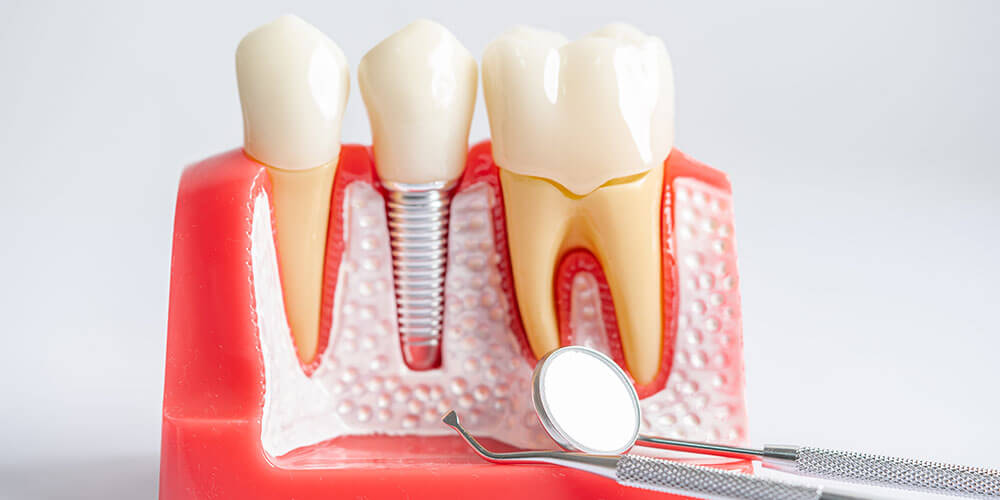
A titanium post is placed in the jawbone, the bone grows onto its surface over several months, and a crown is fitted on top. It is the only option that replaces the root as well as the visible tooth.
In its favour: the neighbouring teeth are not touched, it helps preserve the bone, it is cleaned like a natural tooth, and it has a long track record.
Against it: it takes months from start to finish, it costs the most up front, it needs enough healthy bone or a graft first, and smoking and uncontrolled diabetes raise the failure rate. Many insurance plans limit or exclude implants. More on our dental implants page.
Option two: a fixed bridge
The teeth either side of the gap are prepared for crowns, and a replacement tooth is joined between them. It is cemented in and does not come out.
In its favour: it is usually finished in two visits a couple of weeks apart, it costs less than an implant up front, it needs no surgery, and it feels like your own teeth.
Against it: the neighbouring teeth have to be reshaped for crowns. If they are healthy and unfilled, that is a real cost. If they already have large fillings, crowning them can be a benefit. The area under the replacement tooth needs daily cleaning with a floss threader. More on our dental bridges page.
Option three: a removable partial denture
A replacement tooth, or several, on a plate or light metal frame that clips to the remaining teeth and is taken out to clean.
In its favour: it is the least invasive and least expensive option, it can replace several gaps at once, and it can be added to if more teeth are lost later.
Against it: it moves slightly when you eat, it takes some getting used to for speech, it does nothing to preserve bone, and the clasps put some load on the teeth they grip. More on our dentures page.
The comparison at a glance
- Time to finish: denture a few weeks, bridge about two weeks, implant several months.
- Cost up front: denture lowest, bridge in between, implant highest.
- Effect on neighbouring teeth: implant none, bridge they are crowned, denture clasps rest on them.
- Effect on the bone: only an implant helps preserve it.
- Removable: only the denture.
What your insurance is likely to pay
Bridges and dentures usually sit in the major services category of a private plan, covered at a lower percentage and counted against the annual maximum. Implants are often limited or excluded, and some plans pay for the crown on top but not the surgery. The Canadian Dental Care Plan covers dentures, with partial dentures needing preauthorization. For anything in this article we can send a predetermination to your insurer so the figures are in writing before you decide.
Timing matters too. If treatment is planned for late in the year, part of it can sometimes be completed before your plan resets and part after, drawing on two annual maximums. See when dental insurance resets.
How the decision gets made
It starts with an examination and radiographs, which show the health of the neighbouring teeth and how much bone there is. We will then lay out the options that genuinely suit your mouth, what each costs and how long it takes, and what we would choose if it were our own tooth. If a tooth has not been lost yet and the question is whether to save it, read saving a tooth or extracting it first, because keeping a tooth is usually better than the best replacement.
Panacea Dental is at 105 Clappison Ave #103 in Waterdown, open Monday to Friday from 10:00 am to 7:00 pm and Saturday from 10:00 am to 3:00 pm. We are accepting new patients. Call 289-408-5100 or book online.